-
William E. Lamb Jr., Class of 1967. Lamb Jr. describes his childhood as the son of a decorated Navy aviator, including frequent relocations in the United States and abroad. He discusses his evolving views of the Vietnam War during his time at Dartmouth, where he both held a Navy ROTC scholarship and joined an antiwar vigil on the College Green. Following graduation, Lamb Jr. served aboard a Navy ship and challenged his commanding officer’s abuses of the military justice system. He was subsequently reassigned to the Korean Army’s Maeng Ho division in Vietnam, where he discovered stark differences between American and Korean approaches to soldier involvement in the war. Upon completing his military obligation, Lamb Jr. pursued careers in criminal justice reform, auto repair education, real estate, software, construction, fast food, and more. Finally, Lamb Jr. reflects on his twenty-five-year alumni reunion, the lasting trauma of Vietnam for all those involved, and connections to the contemporary political climate.
-
Interview with David “Jake” Guest, Class of 1966. Guest discusses his life growing up in Hanover, where he attended Hanover High School and then Dartmouth College. Encouraged by Dean Thaddeus Seymour to take a few years off from his studies, Guest joined the Army and was deployed in Germany. Guest reflects on his growing disillusionment with the military and eventual discharge, which propelled him to travel Europe and the Middle East. Guest then discusses his return to Dartmouth and his involvement in anti-war activism. Finally, Guest details his experience with the Wooden Shoe Commune and his contributions to the Upper Valley community through organic farming.
-
Oral history interview with James Harlow, resident of the Upper Valley currently residing in Thetford, VT. He was drafted into the army, and was deployed in Vietnam from 1971 until medical issues sent him home in 1972. He briefly lived a regular civilian life, but re-enlisted into the military in 1973 – marking the beginning of a career that would last until 1992. Jim was a combat engineer and spent time as a minesweeper in a modified bulldozer after the prior operator was injured. In this interview he discusses his experiences in Vietnam, the Gulf War, and his perceptions of society, religion, and drugs during the Vietnam war era.
-
In this oral history interview, Dr. Trey Pham recounts his journey from Vietnam to the United States as a refugee. Born in Saigon in 1972, he shares early memories of his childhood in Vung Tau, a small town where he grew up. In 1979, his family fled Vietnam to escape forced enlistment, enduring a harrowing boat journey, multiple pirate attacks, and weeks at sea before reaching an Indonesian refugee camp. He then describes his family’s resettlement in Kansas City, where they faced economic struggles and cultural adaptation, emphasizing his mother’s resilience and the importance of education. He eventually pursued medicine, completing a decade-long path to becoming a radiologist. Dr. Pham reflects on the Vietnam War’s lasting impact, the hardships of displacement, and the sacrifices made for a better future. His story highlights the resilience of refugees, the challenges of assimilation, and the enduring strength of family and cultural heritage.
-
In this second interview with the DVP, Lai Maccarone moves beyond the chronology of her life to reflect on how her experiences with both her foster families and her biological family have shaped her sense of love, belonging, and identity. A refugee from Da Nang, Vietnam, Lai fled with her mother and several siblings to the United States as an infant, escaping the final days of the Vietnam War. In her first interview, she recounted the timeline of her life, including her early years in the U.S., the loss of her mother, and her journey of reconnecting with her family in Vietnam. In this new interview, she explores the emotional impact of those experiences, examining how they influenced her relationships with her siblings, foster families, and children. Additionally, she discusses familial bonds, a significant health crisis, and her identity as a Vietnamese refugee during a time of national racial reckoning.
-
Dartmouth alumnus Robert W. "Obie" Holmen, Class of '72, served in Vietnam between 1968 and 1970. In this oral history interview, he describes his early childhood in rural Minnesota and his journey to Dartmouth, initially as part of the Class of '70. In light of personal challenges, he took a leave of absence from Dartmouth and enlisted in the U.S. Army in 1968. First assigned as an infantryman in Charlie Company, 3rd battalion, 8th infantry, Obie was re-assigned into the Long-Range Reconnaissance Patrol (LRRP) unit in the 75th Infantry Battalion Rangers. Finishing his service in December 1970, he returned to Dartmouth in January 1971 and graduated as part of the Class of ‘72 with a degree in History. He went on to receive a Juris Doctor degree from the University of Minnesota, pursued a career in law, engaged in theological studies, and became a freelance writer.
-
This oral history explores the life and Vietnam War service of Jeff Danziger, award winning cartoonist who currently resides in Brattleboro Vermont. Danziger, a New York native, attended the University of Denver before moving to Plainfield, Vermont. Danziger was drafted into the US Army in 1966, and tried to avoid deployment to Vietnam by attending language school and by becoming an officer. He served in Vietnam from 1970-1971, where he worked in various capacities for the First Cavalry Division and also served as an advisor to the South Vietnamese Army during the period of the “Vietnamization” of the war. In addition to discussing his wartime experiences in Vietnam, Danziger also reflects on postwar writings and films about the war, American attitudes towards veterans, and his return to Vietnam as a journalist years later.
-
Professor of History and Foreign Policy at Hofstra University. This oral history interview documents Dr. Eisenberg’s experience growing up in suburban New York during the rise of Civil Rights and antiwar movements. She describes experiencing censorship in high school during the McCarthyism era and protesting segregation as an undergraduate student at the University of Chicago. Further, she reflects on her experiences partaking in the 1968 Hamilton Hall Occupation at Columbia University while in pursuit of a Ph.D. She discusses her time teaching at Dartmouth from 1971-1975 and 1988-1990, including her participation in civil disobedience against the draft. Finally, she recalls her experience teaching part-time at the Center for Worker Education while tenured at Hofstra University and conducting research in Vietnam for her recent book, Fire and Rain: Nixon, Kissinger, and the Wars in Southeast Asia.
-
Oral History Interview with William Donahue, who served in the Vietnam War. He first recounts his upbringing in Washington, D.C., and his higher education at Colby College. Donahue shares his path to enlisting in the Marine Corps after being denied a student deferment for law school. He describes the various training camps he attended before arriving in Vietnam, where he began as an infantry officer in 1967. Just as the Tet Offensive began in 1968, he was transferred to the Military Police Corps but soon returned to his infantry position. He describes his experiences on and off the battlefield andthe relations between the men in his battalion, especially concerning race. Post-Vietnam, he continued his service as an instructor at Camp Lejeune, a training camp in North Carolina, and ended his active duty as a soldier in Guantanamo Bay, Cuba. Donahue closes out the oral history by detailing life after the war and how his perspective on the war has changed over time. Currently, he is writing a memoir about his war experiences.
-
Steve Fowle begins with his family history. Coming from several generations of New Hampshire and Massachusetts residents, he reflects on his family’s deep New England roots and his father’s journey to achieving social mobility. He recounts dropping out of high school and enlisting as an Army Photographer, remembering basic training at Fort Jackson, South Carolina, and photography training at Ft. Monmouth, New Jersey. He recalls arriving in Long Binh in June 1967 and learning he would be a medical illustrator in the morgue for the 9th Medical Laboratory, 44th Medical Brigade in Saigon. He describes daily life in Saigon and taking photographs for pathologists. He reflects on Saigon and his memories from the Tet Offensive. He returned home in June 1968 and discusses reintegration into everyday life, including his travels out West. He talks about his entry into journalism and journey to becoming the lead editor for The New Hampshire Gazette.
-
Allan Campbell ’64 reflects on Dartmouth experience, and the political climate during the early 1960s. After graduation, he attended Officer Candidate School and served four years in the Navy, working as a legal officer aboard the USS Essex. He describes the hierarchy aboard Navy ships, and the experiences of junior officers. While the Essex underwent repairs at Charlestown Navy Yard, Campbell discusses the public criticism he received while living in Harvard Square due to growing anti-war sentiments. After his service, Campbell attended Boston College Law School, and discusses spending his summers teaching at OCS. Following law school, Campbell built a career in corporate law. At the end, he discusses his trip to Vietnam in 2015 with fellow members of the Class of ‘64, reflecting on his own understanding of the war and the legacy it has on his classmates and generation.
-
Michael James Beahan (GR’97) was born in Towanda, Pennsylvania, in December 1945. Beahan went to high school on a military base in Kaiserslautern, Germany before enrolling in Pennsylvania State University, where he joined the advanced ROTC program. Upon graduating in 1967, Beahan was commissioned as a second lieutenant. He spent eighteen months at Maxwell Air Force Base in Montgomery, Alabama before completing six months of intelligence training at Lowry Air Force Base in Denver, Colorado. In 1970, Beahan was assigned to Tan Son Nhut Air Base in Saigon, Vietnam, spending three days before transferring to Udorn Royal Thai Air Force Base in Thailand to complete his one-year tour. He later secured a position with the 7th Airborne Command and Control Squadron (ABCCC). Working as an intelligence officer in an airborne command post over the Plain of Jars region, he flew over 95 twelve-hour combat missions over Laos. Following his military service, he pursued a career in media and technology, including 10 years as Director of the Jones Media Center at Dartmouth College. At the time of this interview, Beahan was retired and living in Lyme, New Hampshire.
-
Joan Rachlin, born April 5, 1949, was among the first cohort of women to be educated at Dartmouth College. Her experience was marked by the political and social unrest of the 1960s and ‘70s surrounding the Vietnam War, women’s rights, and civil rights. Rachlin was a child of activist parents who encouraged her from an early age to get involved and stand up for the rights of others. As a result, she was among the few women participating in antiwar protests at Boston University and Dartmouth College. Later, Rachlin obtained her J.D. and continued her activism while practicing health, criminal, and civil rights law.
-
Robert Munson, a Vietnam veteran, discusses his childhood moving around the United States with his military family. He then discusses his military service beginning with his training at Fort Belvoir in Virginia and his experience as an army engineer. He goes on to talk about his time in Vietnam, beginning with his chaotic introduction to the war in Saigon and Cam Ranh Bay. He goes on to talk about his experiences during the Tet Offensive, and how he earned his Purple Heart. After this, he goes on to speak about his experiences in the latter half of his tour, featuring interactions with his commanding officers and Marines in Hué. After Vietnam, Munson talks about his transition back into civilian life and his career and family relationships. At the end of the interview, he discusses his move to the Upper Valley of Vermont/New Hampshire, his current views on the war, and his interactions with younger veterans.
-

-

-
-

-

Riggs, William Interview Abstract:
1. Childhood and Memories of the Cold War
2. Time at Dartmouth
3. Getting Drafted into the Training Aids Division
4. Support of the Antiwar Movement
5. Completing Service and Final Thoughts
-
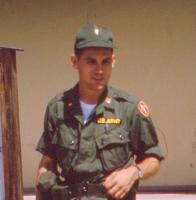
Timothy H. Brooks. Class of 1964. Oral history interview for the Dartmouth Vietnam Project. Brooks describes growing up in Hampton, New Hampshire. He describes his older brothers and the death of his father when he was eleven. Brooks discusses his high school career, being valedictorian, and how he discovered Dartmouth. He describes his experience in the Army Reserve Officers’ Training Corps. He discusses his time at Dartmouth as an Economics major and working in the dining hall. Brooks discusses his participation in the radio station as the Record Librarian and the Administrative Director on the governing board. He credits the experience as launching his later career in television in charge of research. He describes the book he wrote on the history of WDCR, the Dartmouth College radio station, as well as other books. Brooks discusses being assigned to Fort Bragg in North Carolina, assigned to the 518th Signal Company in the Army. Brooks explains his arrival to Tan Son Nhut Air Base in Saigon, Vietnam and then later assigned to Vinh Long Helicopter Base as Detachment Commander. He shares how he was struck by the heat, then the people, as well as the boredom he experienced while in Vietnam. Brooks shares how he volunteered to be the Pay Officer to be able to get out of Vinh Long once a month. He explains how he connected with Alan R. McKee, Class of 1964, who was the assistant station manager at the armed forces radio station in Saigon. He describes how he did a Sunday morning radio show in Vietnam for a short time. He explains how his company operated the troposcatter, microwave communications.
-
Susan E. Tavela. Wife of John E. Tavela, Class of 1964. Oral history interview for the Dartmouth Vietnam Project. Tavela explains that she participated in the project because her husband is in a nursing home for dementia and is unable to tell his own story. She describes her childhood growing up across the country and how she met her husband. She describes herself as a civil rights activist and provides a few examples of how she and John participated in protests, marches, and political campaigns. She describes her marriage to John while he was attending Dartmouth. She explains how John was drafted after he completed his graduate studies at Johns Hopkins University. She describes John’s involvement in the Medical Service Corps. Tavela reads a number of excerpts from letters that John sent to her during his time during the Vietnam War. Tavela describes how she believes John’s dementia is a result of his participation in the war. She explains that John had a difficult time transitioning back from the Vietnam War. She shares that John was depressed after he returned home and discusses the impact it had on him personally and on their family.
-

Beers, Rand Interview Abstract:
1. Adolescence in a Military Family
2. Time at Dartmouth and Military Training
3. Vietnam Tour and Extension
4. Transition to Civilian life and Joining the State Department
5. Vietnam’s Impact on Later National Conflicts
6. Experiences with the Second Gulf War
7. Leaving the Bush Administration for the Kerry Campaign
8. Time in the Obama Administration
-

Peter E. Luitwieler. Class of 1964. Son of Clarence Seward Luitwieler, Class of 1924. Oral history for the Dartmouth Vietnam Project. Luitwieler describes his experience as a Dartmouth student participating in the 3-2 program with the Tuck School of Business. Luitwieler shares his experience participating in freshman hockey and football, playing on the rugby team, joining Phi Delta Alpha, and majoring in Spanish. He describes his experience with the Army Reserve Officers’ Training Corps and being classified as 4-F, not fit for service. He describes how his classification was changed and how he was later drafted. Luitwieler discusses his time in Officer Candidate School at Fort Benning. He describes how he wanted to go to language school to learn Vietnamese but was instead selected for Army intelligence and was sent to Fort Holabird, Maryland. Luitwieler describes being sent to the northernmost part of Vietnam, the Quảng Trj Province. He describes his participation in the Phoenix Program and his job doing military intelligence during the Vietnam War.
-

Neal Stanley ‘64 describes his traditional childhood growing up in New Jersey. He goes on to talk about his experiences in ROTC at Dartmouth College, and then discusses becoming a second lieutenant and attending airborne training. He describes his experiences as a communications platoon officer in Nuremberg, Germany, and talks about how he dealt with the complexities of discrimination and conflict among other soldiers he was stationed with. He then discusses his attempt to resign his post, and his eventual assignment to Vietnam just after the Tet Offensive. Stanley then recalls several anecdotes, detailing his interactions with other officers and with Vietnamese culture and people, as well as his experience with clandestine operations in Cambodia. He then discusses his difficulties transitioning back into civilian life. He concludes by talking about his current perspective on the war, his post-military career path, and the importance of Dartmouth in his life experiences.
-

Michael W. Parker. Class of 1964. Oral history interview with the Dartmouth Vietnam Project. Parker describes his time at Dartmouth and his involvement with the Navy ROTC [Reserve Officers’ Training Corps]. He discusses how he participated in the Navy ROTC program throughout the summer. Parker describes how he was able to walk on to the Dartmouth ski team. He discusses his decision to postpone dental school to join the Navy and his experience being sent to Vietnam. Parker describes working on the staff of Admiral Elmo R. Zumwalt Jr. Parker discusses Admiral Zumwalt’s leadership and the ways in which he believed Zumwalt had transformed the Navy. He discusses his work to control the Mekong Delta in Vietnam while aboard the USS Frigate Bird, performing mine countermeasures and swimmer defense operations. Parker details how the Navy developed riverine warfare during Vietnam. After his time in Vietnam, Parker explains how he attended dental school at Tufts University School of Dental Medicine and remained in the U.S. Navy Reserve. He describes being offended by the antiwar acts that his fellow classmates participated in rather than attending class while a student at Tufts. Parker shares how he was sent back to the USS Frigate Bird after he completed dental school. He discusses his career after dental school which included teaching for three years with the Navy Officer Candidate School, four years in Scotland, and 11 years teaching for the Naval Postgraduate Dental School.