-

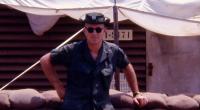
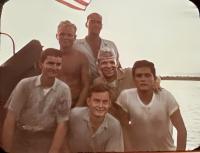
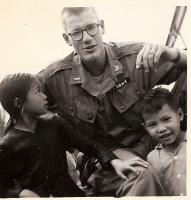
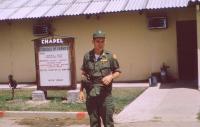
Lee A. Chilcote, Class of 1964, Thayer Class of 1965. Oral history interview documenting his entrance into the Marine Corps; Officer Training School at Quantico, Virginia, in 1965; deployment to Vietnam from 1966-1967 and participation in various operations (notably: Operation Georgia and Operation Hastings); involvement afterwards in the Greek Cypriot War; and return to the United States. Chilcote describes his experience at Da Nang Air Base in An Hoa, Vietnam, and on the Ho Chi Minh trail.
-

Frank, Justin Interview Abstract
1. Early Childhood and Political Consciousness in California
2. Undergraduate Education
3. Med School and Early Activism in Louisville
4. Securing Conscientious Objector Status
5. C.O. Status and Faith, Patriotism
6. Political Engagement and Writing Career in Adulthood
-

James M. Rini. Class of 1964 and Geisel School of Medicine Class of 1966. Oral history interview for the Dartmouth Vietnam Project. Rini describes his experience as a student at Dartmouth. He describes himself as very focused on academics and was called a “dirty booker.” Rini describes participating in crew, the Newman Club, and the ROTC [Reserve Officers’ Training Corps] Mountain Winter Warfare Unit. Rini discusses his transition as a Dartmouth undergrad to the medical school. Rini shares that he graduated from Harvard Medical School in 1968, completed his residency at Cornell University Medical Center in New York City, and his internship was at the University of Minnesota. He discusses his transition to the Air Force in 1972 after he completed his medical training. He describes being sent to Langley Air Force Base and then to Udorn Royal Air Force Base in Thailand. Rini describes his time in Thailand as being boring with little to do. He describes a few medical emergencies he managed while in Thailand. Rini describes his return to Andrews Air Force base. Rini discusses in detail a few incidents that occurred with another officer named Ferguson, who was stationed in Thailand with him. He discusses his experience traveling to Vietnam years later with fellow classmates from the Class of 1964.
-

James Laughlin III, Class of 1964. Oral history interview documenting his service in the United States (US) Army during the Vietnam War. Laughlin recalls his experience in Reserve Officers’ Training Corps (ROTC) at Dartmouth College; his commission as a second lieutenant in the United States Army Reserve; and his active duty service at the Officers Infantry School in Fort Benning, Georgia as a combat intelligence officer in the Military Intelligence Corps of the U.S. Army. He describes taking an intelligence crash course at Fort Holabird and arriving in Vietnam to serve in the II Field Force, near Bien Hoa Air Base. Laughlin discusses his experience during the Tet Offensive and his later assignment to the Military Assistance Command in the Mekong Delta. He recalls missions completed, including aerial reconnaissance operations in the IV Corps. Laughlin shares his views of the Vietnam War, his thoughts on government and the role of the soldier in that war as compared to more current wars (Afghanistan and Iraq). He also describes the effect of Agent Orange on him, and the treatment of veterans with other war-related disabilities by the United States Department of Veterans Affairs.
-

Ivars Bemberis. Class of 1964. Oral history interview for the Dartmouth Vietnam Project. Born in Latvia, Bemberis discusses his childhood in German displaced persons’ camps as a result of World War II. He describes his journey to the United States and the influence of his mother and father on his world outlook. At Dartmouth, Bemberis reflects on his college years through the lens of being a student on scholarship. He explains his transition from undergraduate to graduate school to officer basic training at Fort Belvoir. Bemberis describes civil affairs school and his deployment to the 41st Civil Affairs Company in 1967. He details his assignment to Edap Enang Resettlement Camp, and reflects on the connection between his experience as a displaced person and his refugee work. Then, Bemberis shares his experience returning home to his wife and young son. Finally, Bemberis shares how his Vietnam service continues to facilitate his ability to forge connections.
-

Hugh P. Savage. Class of 1964. Oral history interview for the Dartmouth Vietnam Project. Savage discusses his childhood in Scarsdale, New York and his participation in Boy Scouts. He describes his experience as an engineering student at Dartmouth and his involvement with the Army ROTC [Reserve Officers’ Training Corps]. He discusses his involvement in Kappa Kappa Kappa and how his Christian values were important throughout his time at Dartmouth. Savage describes how the Army was his third choice branch when enlisting in the military. He discusses how he knew he would be drafted so instead he went directly into active duty, and not Officer Candidate School, after graduating from Dartmouth. Savage describes his job as an Army Executive Officer and later platoon leader while in Vietnam. He describes his job as involving a lot of manual labor, and notes that he was tasked with enforcing the perimeter. Savage describes the relationships he had with his subordinate soldiers. He explains his difficult transition back from Vietnam and his time spent getting his master’s in engineering at Northeastern University. Savage discusses his relationship with his fiancée after the war. He explains how he returned to the Army Reserves and was exempted from active duty.
-

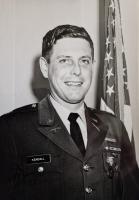
Glen R. Kendall, Dartmouth College Class of 1964, Tuck School of Business Class of 1971. Oral history interview documenting his service in the United States (US) Army during the Vietnam War. Kendall discusses his experience at Dartmouth studying economics and participating in Reserve Officers’ Training Corps (ROTC). He describes his time in an Infantry Officer Basic Course (IOBC) at Fort Benning, Georgia, and his assignment to an infantry position in Europe, as Captain of the Airborne Mechanized Infantry Brigade in Mainz, Germany. In Vietnam, he was in the 196th Light Infantry Brigade in Chu Lai. He then became battalion staff (battalion logistics officer) near Tam Ky. Kendall returned to the US after sustaining injuries in a firefight and was subsequently awarded a Purple Heart. He discusses his opinion of war, the Iraq War, and the U.S. Department of Veterans Affairs (VA).
-

Francis C. “Bud” McGrath. Class of 1964. Oral history interview for the Dartmouth Vietnam Project. McGrath shares details about his childhood in Massachusetts. He describes his transition to Dartmouth. He explains how he began as an engineering major and quickly began looking for a new major and became an English major. He discusses his participation in Alpha Theta fraternity, the Newman Club, and playing on the hockey team. He describes his involvement with the Army ROTC [Reserve Officers’ Training Corps]. McGrath explains how he went directly into the Army after graduation. McGrath discusses why he selected to take a regular commission and his time spent in the Army. He explains how he began in Germany for two years, went to Fort Huachuca in Arizona to train soldiers going to Vietnam, and finally was sent to Vietnam for one year beyond his initial commitment to the military. He discusses his job as a company commander and his experience in Vietnam. McGrath shares how he became disillusioned and untrusting of the Army during his year in Vietnam. He describes his transition back to the United States after his tour in Vietnam. He describes how he became involved in antiwar activities as a graduate student at the University of Texas, Austin. McGrath describes his career path after graduate school. McGrath describes his involvement with Professor Edward Miller’s course at Dartmouth.
-

Dr. Donald C. Bross. Class of 1964. Oral history interview for the Dartmouth Vietnam Project. Bross discusses growing up in Denver, Colorado. He describes his relationship with his mother, a women he describes as ahead of her time. He explains how he became involved with the military and his participation in the Reserve Officers’ Training Corps (ROTC) in high school and later at Dartmouth. He describes his relationship with his uncle Jim and shares stories of Jim’s career in the military. He explains how he knew from an early age that if he wanted to go to college he would have to work hard and find a way to get there on his own, therefore his involvement in ROTC. He describes his time spent in high school working, studying, and participating in the chess club, school senate, becoming an Eagle Scout, and other activities. Bross describes his experience in the Boy Scouts of America and shares stories about his scout leader. Bross describes how he discovered Dartmouth and how 14 other men from Denver also attended Dartmouth during his time. He describes living in Russell Sage Hall, at the time known as Bear Farm or Yellowstone the Second. He discusses the frat system, and socio-economic differences on campus. Bross discusses his summer spent with the Navy ROTC in Florida and his experience flying. Bross describes his experience as a student abroad in Peru. He explains that his time in Peru, growing up in Colorado, career as a Dartmouth student, participation in President Kennedy’s People to People Student Ambassador Program Alliance for Progress in Latin America, and military experience at a young age all contributed to his unique perspective as an enlisted officer. He discusses his first assignment in the Navy, and his experience on a Swift boat in Vietnam. He describes the experience of losing his friend William B. Nickerson, Class of 1964, who died in Vietnam. Bross describes the importance of water transport as it relates to the economy and the Navy. He discusses his experience in graduate school and his career in family psychiatry and child abuse. He shares stories about his mentors from college and his career, in particular, Henry C. Kempe.
-

Anthony (Tony) Thompson, Dartmouth Class of 1964, enlisted in the US Army in 1963 after taking a hiatus from college on the recommendation of his dean. He went to Vietnam to support US military advisory operations there during 1963-1964. He spent six months rotating in and out of A Loui and Tabat in the A Shau valley. During the latter part of his deployment he was attached to the decorated ARVN 1st regiment, which operated near the demilitarized zone between North and South Vietnam. He witnessed the destruction of that unit in a battle in March of 1964. He earned a bronze star and the South Vietnamese Cross of Gallantry. In the interview, Thompson discusses the executions of civilians and prisoners that he witnessed in Vietnam. He also talks about criticism he faced from antiwar students after he returned to Dartmouth, and how this prompted him to move off campus. He eventually left the United States and spent several years in the more congenial environment of Australia, before returning to Vermont to work in business in the 1990s. Finally, Thompson discusses his current perspectives on the war and his disagreements with those who say that it was not worth fighting.
-

David H. Kruger, Dartmouth Class of 1964. Oral history interview documenting his experience as a Dartmouth College student and his military service during the Vietnam War. Kruger attended Phillips Exeter Academy for high school, and spent four years at Dartmouth in the Reserve Officers’ Training Corps (ROTC). He was commissioned as a second lieutenant in the Army and trained in Infantry School at Fort Benning, Georgia. Kruger entered into the Military Intelligence branch (MI) and worked in the United States for the first two years safeguarding information. He then spent one year in An Khê, Vietnam, collecting, synthesizing, and delivering information as the liaison officer to the commanding general of the 1st Cavalry Division (1st Cav). Kruger left Vietnam in January of 1967. He was registered as a disabled veteran at Walter Reed National Military Medical Center, and then spent a fourth year in the army at Fort Belvoir, Virginia. Kruger left the army and went into the private insurance sector, working for the same company for 30 years and retiring at age 55. He discusses his travels, his return (multiple times) to Vietnam, and his retirement. He published a family history, winning the Donald Lines Jacobus Award (National prize for genealogy), and joined the boards of Wentworth Institute of Technology and New England Historic Genealogical Society. He has since published other family histories. Kruger also discusses his geopolitical views of current events, and of the Vietnam War.
-
-
-
-
-
-
-
-
-
Oral History Interview with Peter C. Sorlien for the Dartmouth Vietnam Project. A member of the Dartmouth Class of 1971, Sorlien’s time at Dartmouth was heavily influenced by his involvement in antiwar activism against the Vietnam War. Arriving at Dartmouth in the fall of 1967, Peter enrolled in the College’s ROTC program, succeeding his brother, Cai Sorlien ‘67, who served in Vietnam in 1967-68. In his second term on campus in the winter of 1968, Peter became more skeptical of the War and began participating in the Antiwar Movement. On February 28, 1968, Peter protested on the Green in his ROTC uniform and was subsequently dismissed from the military program. Sorlien discusses what moved him to stand up against the war, coming back to a different Dartmouth after going abroad to France and Germany in 1970, and the lasting effects of the war on his outlook on life and institutions.
-
This interview, conducted on October 27, 2020 with Mr. Michael Heaney for the Dartmouth Vietnam Project, begins with Heaney’s childhood. He discusses how his father’s service in WWII influenced him from a young age. While a fighter pilot in the pacific theater, his father kept a detailed combat diary, which Heaney recalled reading very closely in his early years. He discusses his activities in school, where he maintained multiple peer leadership positions. He goes on to describe his ROTC program at Middlebury College, which led him to enlist in the US Army. After joining the Army, Heaney participated in several training camps, including ROTC, basic infantry training, Ranger school, and jump school. He then discusses his arrival in Vietnam, the men with whom he became acquainted, and ultimately the ambush he experienced on May 16-17, 1966. Heaney discusses the hours-long firefight where he was wounded in the right calf. From this point in the interview, he transitions to discussing the experience of telling the traumatic story of the ambush during multiple interviews in which he has taken part over the ensuing decades. He recounts that upon returning home from the hospital, his parents asked to read his combat diary rather than discuss his experiences openly. The interview ends with Heaney’s reflections on the experience of being interviewed for the Ken Burns and Lynn Novick documentary series, The Vietnam War, and its role in establishing the collective memory of the Vietnam War.
-
Abstract coming soon
-
Jack "Doc" Cassidy was born on June 18, 1946 in New Haven, Connecticut, into a blue-collar family. During his teenage years, Cassidy focused on his budding football career and spending time with friends in his neighborhood. Cassidy failed in his first attempt at college, leading him to join the Navy Reserve as a Hospital Corpsman in early 1966. Cassidy attended Basic and Hospital Corpsman Training, where he contracted a dental infection that delayed his graduation. This delay altered his service trajectory: Cassidy now had to attend Combat Corpsman School in Camp Lejeune, North Carolina, and would eventually be deployed to Vietnam. Cassidy arrived in Vietnam during the late summer of 1968, where he was attached to Kilo Company, of the 3rd Battalion, 1st Marines, who at the time were in Thuong Duc, an area in I Corps near the Laotian border. Cassidy went on to serve in the “Arizona Territory” near An Hoa as well. During his interview, he speaks of racial tensions in his unit, opinions of officers and fellow enlisted men, “euphoric recall,” wound care, booby traps, drug use, an eventful R&R trip to Singapore, reunions, and the overall Corpsman experience in Vietnam.
-
Bruce Boedtker was born 1950 in Glen Cove, Long Island, but spent much of his early life moving from place to place. Boedtker felt most at home on his grandparents’ farm in Springfield, Vermont, where he eventually lived full time and attended school. He volunteered for the Army after dropping out of high school and receiving a low lottery number in the draft. He served during a period of US troop withdrawal in the Vietnam War. Boedtker began his basic training on September 14, 1970 at Fort Dix, New Jersey, then completed Advanced Infantry Training at Fort Polk, Louisiana. Initially enlisted to serve in Vietnam, his orders changed, and he was deployed to Wildflecken, Germany. There he served as an Infantry Private with the 3rd Infantry Division as part of the US Army’s presence in the NATO alliance to defend the Czech border. During his service, Boedtker describes being bored and aimless, until his Company Commander offered him a job as his driver. Boedtker describes this opportunity as a major turning point in his life, as it gave him a greater sense of purpose through his responsibility of leading drills. His main connection to the Vietnam War was through the Vietnam veterans sent to Europe to finish out their tours and the stories they told. They often described the lack of discipline and strategy that caused the chaos and unrest in Vietnam. Boedtker was discharged on April 18th, 1972. He returned to Vermont, where he received a degree in engineering from the University of Vermont and eventually ran his own business. Today, he lives there with his family.
-
Dennis Bidwell ’71. Oral History Interview for the Dartmouth Vietnam Project. Bidwell discusses his childhood in Denver during the 1950s and early 1960s. He then shares his Dartmouth experience through debauched dorm life, his emerging political awareness during a study abroad term in Bourges, France, his shift to majoring in government, his teaching as a Tucker Foundation intern in Jersey City, NJ, and his involvement in the antiwar movement, including with the Congressional lobbying group, Continuing Presence in Washington (CPW). He also describes watching the 1969 draft lottery, applying for Conscientious Objector (CO) status, and conflicts with his father over his CO application. Bidwell describes his post-graduation move to Boston, work in community organizing and education, and deferring his acceptance to NYU Law School in anticipation of alternative service. Bidwell describes his later career change to nonprofit funding and real estate philanthropy and his move to Northampton, MA. Finally, he offers final reflections on his activism and on healing familial rifts over the war.